
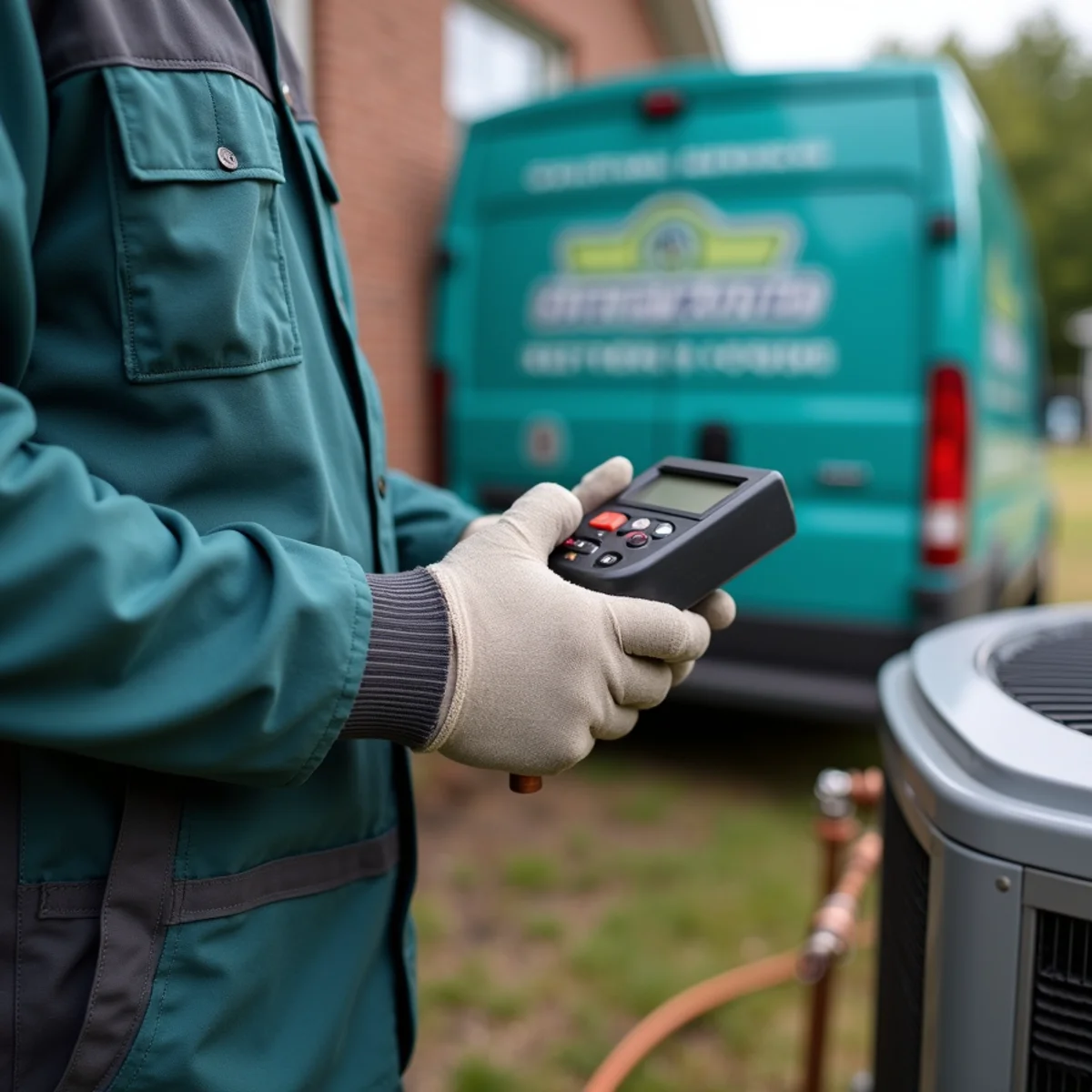
If your AC needs a recharge every summer, you have a refrigerant leak, not a normal maintenance need. Here are the warning signs.
Refrigerant Doesn't Get Used Up
If your AC needs a recharge every summer, you have a refrigerant leak, not a normal maintenance need. Refrigerant circulates in a sealed loop and is never consumed, so any drop means it escaped. Warning signs include weak cooling, ice on the lines, hissing sounds, and rising bills. The real fix finds and seals the leak, not just tops it off.
Let us clear up the biggest misconception first: refrigerant, whether older R-22 or modern R-410A, is not fuel and does not get consumed. It circulates endlessly in a sealed loop, absorbing heat inside and releasing it outside. So if your AC is low on refrigerant, it did not burn through it, it leaked out somewhere. That is a repair, not routine maintenance.
This matters because some homeowners get talked into a recharge every summer as if it is normal upkeep. It is not. If you are adding refrigerant year after year, you have a leak that should be found and fixed, both to save money and because refrigerants are potent greenhouse gases.
The Warning Signs to Watch For
A refrigerant leak reveals itself in several ways. Learning to recognize them helps you catch the problem before the compressor gets damaged from running low on charge.
The clearest sign is an AC that cooled fine last year but struggles this year, or one that has needed a recharge before. But there are other tells worth knowing.
- Weak cooling, the AC runs constantly but the house stays warm.
- Ice or frost on the refrigerant lines or the indoor coil.
- A hissing or bubbling sound near the lines or coil.
- Higher energy bills as the system works harder for less cooling.
- Needing a refrigerant recharge in a previous season, a clear leak sign.
Why Just Topping Off Is a Mistake
It is tempting to just add refrigerant and move on, and some companies will happily do that every year. But it is throwing money away and skirting the real problem. The refrigerant will leak out again, you will lose cooling again, and meanwhile the escaped refrigerant harms the environment. Federal EPA 608 rules govern refrigerant handling for good reason.
There is also a mechanical cost. Running an AC low on refrigerant makes the compressor work harder and hotter, and compressor failure is often the most expensive repair on the system, sometimes enough to justify full replacement. Fixing the leak protects that expensive component. Our refrigerant leak repair service finds the actual leak and fixes it.
How We Find and Fix Leaks
Proper leak repair starts with finding the leak, which takes the right tools and training, electronic detectors, UV dye, or nitrogen pressure testing depending on the situation. Once located, we repair or replace the leaking component, whether it is a corroded coil, a loose fitting, or a damaged line set, then recharge to the manufacturer's exact specification.
That is the difference between a fix that lasts and a recharge that fails again next summer. Our AC repair technicians handle leaks for homeowners across Somerset, including neighborhoods like Oaklawn, and we do it the right way the first time.
Where AC Systems Actually Leak
Leaks are not random. After enough service calls, you learn where refrigerant tends to escape, and that knowledge speeds up the hunt. The Schrader valve cores, the little service ports where a technician connects gauges, are a classic slow-leak point, cheap to replace and often overlooked. Brazed joints and flare fittings on the line set loosen or corrode over time, especially where lines pass through a damp crawlspace.
The evaporator coil is the expensive one. Indoor coils develop tiny pinholes from formicary corrosion, a reaction driven by volatile compounds in household air that eats microscopic tunnels through the copper. These leaks are hard to see and often mean the coil itself needs replacing. Knowing formicary corrosion is common helps us set honest expectations: sometimes the smart repair is a new coil, not a patch that will fail again.
- Schrader valve cores at the service ports, a cheap, common slow leak.
- Flare fittings and brazed joints on the line set, especially in damp crawlspaces.
- Evaporator coil pinholes from formicary corrosion.
- The outdoor condenser coil, vulnerable to debris and lawn-equipment strikes.
- The compressor and its solder joints, less common but serious when it happens.
Why a Proper Repair Takes Time
A real leak repair is not a five-minute top-off, and it should not be sold as one. Doing it right protects the compressor and keeps the fix from failing next season.
- 1. Locate the leak with an electronic detector, UV dye, or a nitrogen pressure test.
- 2. Recover the remaining refrigerant properly under EPA 608 rules, never venting it.
- 3. Repair or replace the failed component, whether a valve core, joint, or coil.
- 4. Pressure-test with dry nitrogen to confirm the system holds.
- 5. Pull a deep vacuum to roughly 500 microns to remove moisture, then weigh in the exact factory charge.
Stop Paying for Recharges, Fix the Leak
If your AC has needed refrigerant more than once, or it is showing the signs above, stop paying to top it off and get the leak fixed. Call HVAC Somerset KY at +1 (327) 210-5999 and we will find the source, repair it properly, and recharge to spec so your cooling actually lasts. We are a local family business that follows EPA guidelines and does honest work, no repeat recharges, just a real fix.
Quick Answers
Frequently Asked
No. Refrigerant circulates in a sealed loop and is not consumed. If your AC is low, it leaked out somewhere. Needing repeated recharges means you have a leak that should be repaired, not topped off.
Yes. It reduces cooling, raises your energy bills, strains the compressor toward an expensive failure, and releases greenhouse gases. Finding and fixing the leak is the smart, responsible choice.
R-22 is phased out and increasingly scarce, so it is costly. If your R-22 system leaks repeatedly, fixing the leak, or upgrading to a modern system, usually beats paying rising recharge prices. Call +1 (327) 210-5999.
We use the right tool for the situation, an electronic leak detector, UV dye that shows up under a lamp, or a dry-nitrogen pressure test that reveals where the system loses pressure. Once we confirm the exact spot, we repair it, then verify the system holds before recharging.
Often the honest answer is to replace the coil rather than patch it. Coil leaks from formicary corrosion are tiny and tend to spread, so a spot repair frequently fails within a season. We will show you what we find and lay out repair-versus-replace costs so you can decide.
Need a hand from a real Somerset tech?
Same-day service across Pulaski County — 24/7 emergency dispatch, nights, weekends & holidays.
Related Services
How We Can Help
Serving


